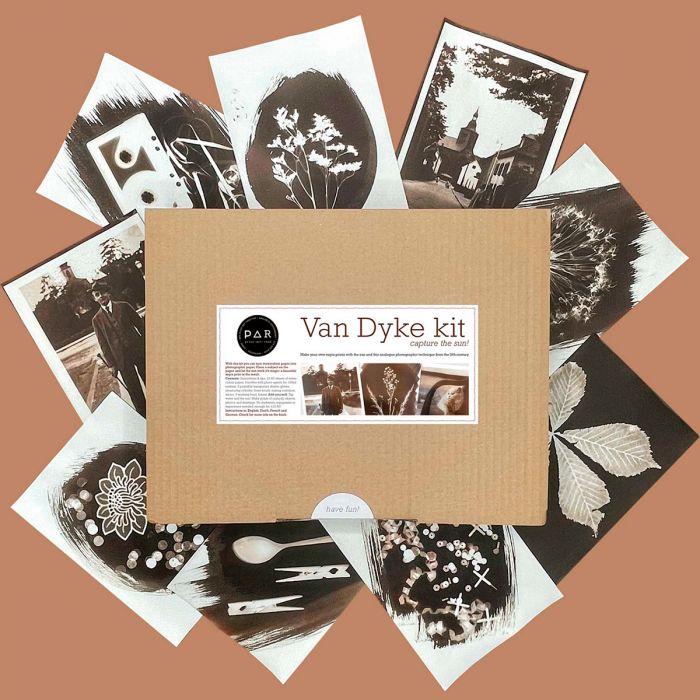
Van Dyke Brown Kit – Historical Photographic Process
The Dutch manufacturer PAR (Print-Art-Read) is one of the few currently developing kits focused on historical photographic processes and solar reactive techniques beyond cyanotype. Alongside classic cyanotype kits, their catalogue includes less common proposals such as Van Dyke Brown, lumen print and other experimental formats designed to explore early photographic techniques without the need for a darkroom.
Among these proposals is this Van Dyke kit, one of the few currently available for experimenting with this historical photographic process. Van Dyke Brown belongs to the group of so-called alternative photographic processes, recovered in recent years by artists and workshops working with manual printing and contact image-making.
The Van Dyke Photographic Process
The Van Dyke process originates in the early developments of photography in the 19th century. Like other techniques that preceded analog photography, such as collodion, calotype or salted paper, the Van Dyke process includes silver nitrate in its composition.
As with other solar reactive processes, this method uses a specific mixture of photosensitive salts that, when applied to paper and exposed to sunlight or ultraviolet light, react to form the image. After washing and fixing, the result is a photographic print in deep brown tones.
The emulsion used for the Van Dyke process is based on a combination of three main components:
-
Ferric ammonium citrate
-
Tartaric acid
-
Silver nitrate
Although its preparation is somewhat more complex than cyanotype, once the emulsion is applied the functioning of the process is fairly similar: the image appears after exposure to light and subsequent washing and fixing. The result, however, is not blue but a print in warm brown and sepia tones, very close to the look of many antique photographs.
The Van Dyke process is still used today in alternative photography, printmaking and analog contact image processes.
What’s Included in this Van Dyke Kit
The kit includes the chemicals needed to prepare the photosensitive mixture, together with the materials and tools for working on watercolour paper.
Kit contents:
-
step-by-step instructions in 4 languages
-
4 bottles containing the photosensitive components
-
20 sheets of watercolour paper, 15 × 21 cm
-
2 rectangular washing trays
-
protective gloves
-
5 inkjet printable transparencies
-
100 ml measuring cylinder
-
foam brush for applying the emulsion
-
mixing tray
-
funnel
-
stirring rod
The mixture included in the kit makes it possible to prepare enough emulsion for approximately 25 A4 sheets, allowing further experimentation beyond the paper included.
What You Can Do with this Kit
The Van Dyke process allows you to work with different kinds of image through direct exposure.
Some typical possibilities include:
-
making photographic prints from negatives or printed transparencies
-
creating photograms by placing objects on the paper
-
working with drawings or illustrations created by hand or digitally printed onto transparencies
This type of contact printing allows you to experiment with historical photographic processes and obtain images with a very distinctive character, close to the earliest methods of photographic reproduction.
An Alternative to Cyanotype
For those who already know cyanotype, the Van Dyke process is an interesting way to continue exploring historical photographic techniques. It is somewhat more complex, but still accessible and relatively easy to learn.
Both systems use photosensitive emulsions applied to paper and exposure to light, but the visual result is very different: while cyanotype produces blue images, Van Dyke creates prints in brown or sepia tones.
Exposure with Sunlight or UV Lamps
Van Dyke prints can be made simply using sunlight, although it is also possible to work with UV lamps or exposure units similar to those used in screen printing and other photomechanical processes.
Using artificial light makes it possible to control exposure times more accurately and work more consistently throughout the year.
Responsible Production
Kits from the Dutch manufacturer PAR are assembled in a local workplace in the Netherlands that employs people with limited access to the standard labour market.
The product has also been designed with sustainability and recyclability in mind.
Frequently Asked Questions
Is it dangerous to work with these chemicals?
The products included in the kit should be handled following the manufacturer’s instructions. As with many historical photographic processes, it is advisable to use gloves and work in a ventilated space.
Can I use photographs with this system?
Yes. Images can be exposed using negatives or transparencies placed over paper coated with the Van Dyke emulsion.
Can the Van Dyke process be used on fabric?
Although it is possible, it is not the most common use. The Van Dyke process is mainly intended for cotton paper or watercolor paper, where the emulsion is properly absorbed.
Do I need a photographic darkroom to use this kit?
No. The Van Dyke process can be carried out simply with sunlight or a UV lamp.
Is Van Dyke similar to cyanotype?
The working principle is similar, but the visual result is different: cyanotype produces blue images, while Van Dyke creates prints in brown or sepia tones.
If you are interested in the classic cyanotype process, you can also see our cyanotype kits for paper or textile.
If you want to continue experimenting with other solar printing techniques, you can also discover the Lumen Kit, based on direct light reactions on photosensitive paper.