UV LED Vacuum Exposure Unit for Screen Printing – 50 × 60 cm
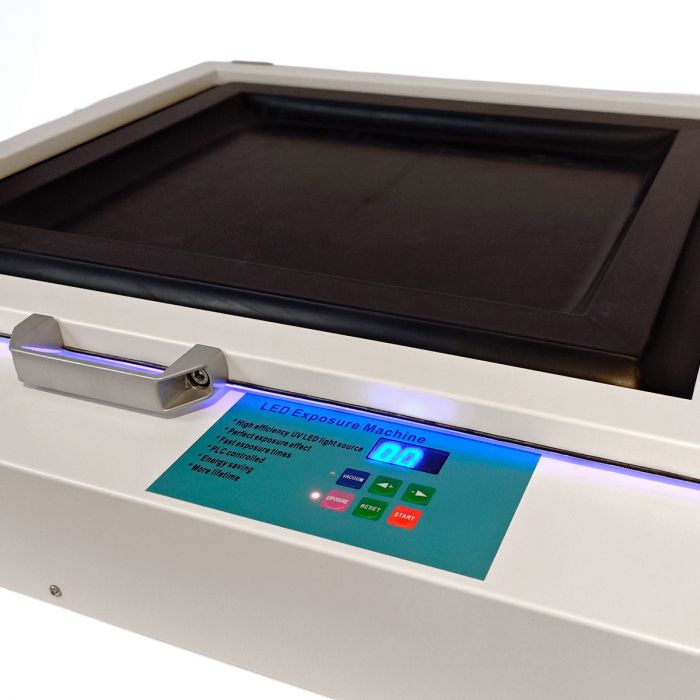
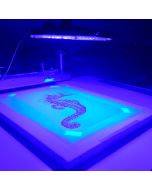
This UV LED vacuum exposure unit provides controlled and repeatable screen exposure by combining a 395 nm UV-A LED light source with a vacuum system that keeps the film positive in close contact with the photosensitive emulsion during exposure.
It is particularly suitable for artists, art and design schools, printmaking studios and small screen printing workshops looking to move from simpler exposure setups to a dedicated screen exposure unit with professional features, without the cost and size of larger industrial equipment.
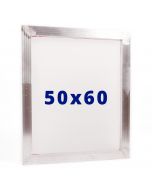
This model has a maximum exposure area of 52 × 61 cm and is recommended for screen printing frames with an internal screen area of up to 50 × 60 cm, using either wooden or aluminium frames.
Vacuum System for Accurate Film-to-Screen Contact
Good screen exposure depends not only on the light source. Close contact between the film positive and photosensitive emulsion is equally important.
The exposure unit incorporates a vacuum pump capable of reaching 80 kPa (0.08 MPa). The vacuum keeps the positive in close contact with the screen during exposure, reducing the gap between the artwork and emulsion and helping to maintain definition in fine lines, small details and halftone work.
Vacuum is generated through a lower suction system, so there is no need to place a cord around the screen frame to assist air removal. This simplifies screen preparation and reduces unnecessary handling of the rubber vacuum blanket.
The system can be used with both wooden screen printing frames and aluminium screen printing frames, provided their dimensions are compatible with the exposure unit.
Vacuum and exposure are controlled independently. The vacuum system is activated first to establish proper contact between the film positive and screen. The programmed exposure cycle is then started manually. Exposure does not begin automatically once the required vacuum has been reached.
395 nm UV-A LED Light Source
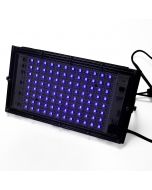
The exposure light source consists of 8 × 10 W UV LED modules, providing a total LED power of 80 W.
The LEDs operate at a wavelength of 395 nm, within the UV-A spectrum.
LED technology provides instant start-up, low power consumption and a compact exposure source, avoiding the higher energy consumption associated with some traditional screen exposure technologies.
Digital Control for Repeatable Screen Exposure
The unit features digital PLC control, an adjustable 0–999 second timer and setting memory.
Once the correct exposure time has been established for a particular combination of screen printing emulsion, mesh, coating and film positive, being able to repeat the same settings helps maintain consistent exposure conditions from one screen to another.
Exposure Times with this UV LED Exposure Unit
The manufacturer gives an approximate reference of 40–70 seconds for certain screens and emulsions, but this range should not be regarded as a universal screen exposure time.
The correct exposure depends on the emulsion and sensitisation system, coating thickness, mesh, mesh colour, optical density of the film positive and other variables. Exposure times may be considerably longer with different emulsions, photosensitive materials or processes.
Exposure times used for screen printing emulsions should not be extrapolated to cyanotype, photopolymer plates or other photosensitive materials. Each process requires its own exposure testing. We therefore recommend carrying out an exposure test or step test before establishing a final working time.
Compact Tabletop Exposure Unit for Studios, Schools and Artists
This machine occupies a useful middle ground between a standalone UV lamp or DIY exposure setup and larger, more expensive industrial exposure equipment.
The combination of vacuum, digital timing and a stable UV-A LED source provides greater control over key screen exposure variables without requiring the investment associated with larger industrial systems.
Its compact tabletop design makes it particularly suitable for art schools, artists, shared printmaking facilities, graphic studios and small professional screen printing workshops with moderate production requirements.
Screen Printing and Other Photomechanical Applications
Although primarily designed for exposing screen printing screens, its 395 nm UV-A LED source can also be used with other photosensitive materials that are compatible with this wavelength.
Potential applications include:
- Screen printing: exposure of emulsion-coated screens using film positives and other suitable positive artwork.
- Offset and other photomechanical processes: compatible photosensitive plates.
- Photopolymer plates: selected plates for letterpress, flexography, pad printing and certain photogravure processes.
- Cyanotype: exposure of sensitised paper, fabric and other suitable substrates.
- SolarFast and other photosensitive systems compatible with UV-A light.
- Alternative and historical photographic processes, including certain Van Dyke processes and other UV-sensitive techniques.
Important: the fact that a photosensitive material can be exposed using 395 nm UV-A LEDs does not necessarily mean that this exposure unit is the optimum light source for that particular process. Spectral sensitivity and required exposure conditions vary between materials and techniques. We recommend checking material compatibility and carrying out exposure tests before establishing a working procedure.
This is particularly important for photopolymer plates, photogravure and alternative photographic processes, where relatively small variations in exposure conditions and processing can significantly affect the final result.
Technical Specifications
- Recommended screen size: up to 50 × 60 cm internal dimensions. This measurement refers to the internal area of a screen printing frame; overall external dimensions will depend on the width and profile of the frame.
- Maximum exposure area: 52 × 61 cm
- Light source: UV-A LED
- Wavelength: 395 nm
- LED power: 80 W (8 × 10 W)
- Maximum vacuum: 80 kPa / 0.08 MPa
- Timer: 0–999 seconds
- Control: PLC with setting memory
- Power supply: 220 V
- External dimensions: 72 × 63 × 14 cm
- Packaging: protective wooden crate, 83 × 81 × 28 cm
- Approximate gross weight: 35 kg
Other UV Exposure Options
If you regularly work with larger screen formats, see our 60 × 80 cm UV LED Vacuum Exposure Unit.
For smaller work, testing or applications where a vacuum system is not required, we also offer portable UV LED exposure lamps kits for screen printing and photosensitive processes. These provide a simpler and more portable approach to UV exposure.
Shipping & Availability
Due to the size and characteristics of this equipment, we recommend contacting Rittagraf before placing your order to confirm availability.
For deliveries outside mainland Spain, please contact us before ordering to check shipping costs, delivery conditions and availability for your destination. International shipping is quoted according to the destination and requirements of each order.
Frequently Asked Questions
What screen size can I use with this exposure unit?
This model is recommended for screen printing frames with an internal area of up to 50 × 60 cm. The maximum exposure area of the unit is 52 × 61 cm.
Should I carry out an exposure test before using it?
Yes. We recommend carrying out an exposure test or step test when working with a new emulsion, plate or photosensitive material. Once the correct exposure time has been established, the timer and setting memory make it easier to reproduce the same exposure conditions.
What type of UV light does the exposure unit use?
It uses 395 nm UV-A LEDs with a total LED power of 80 W.
Why is the vacuum system important?
The vacuum system maintains close contact between the film positive and photosensitive emulsion during exposure. This helps preserve image definition, particularly when reproducing fine lines, small details and halftones.
Can I use wooden and aluminium screen printing frames?
Yes. The unit can be used with both wooden and aluminium frames, provided the overall screen dimensions are compatible with the machine.
Can this exposure unit be used for cyanotype?
Its 395 nm UV-A output allows it to be used with compatible photosensitive processes, including cyanotype. However, exposure times must be established through testing and should not be extrapolated from those used for screen printing emulsions.
Can I use it to expose photopolymer plates and photogravure work?
It can be used with plates whose spectral sensitivity is compatible with 395 nm UV-A light. This does not necessarily mean that it is the optimum exposure source for every plate or photogravure application, so we recommend checking the plate specifications and carrying out tests before establishing a production workflow.
Is shipping included?
Shipping conditions depend on the destination. For international orders, please contact Rittagraf before purchasing so we can confirm availability, shipping costs and delivery conditions for your country.