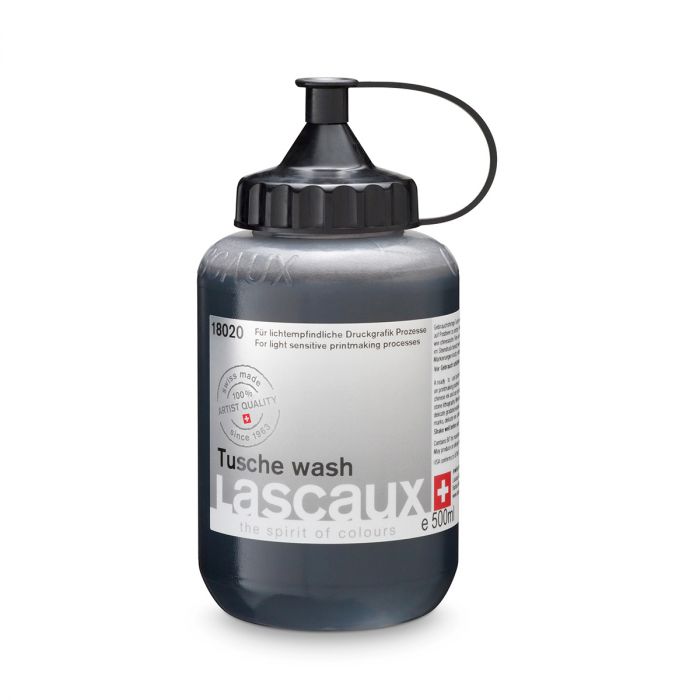
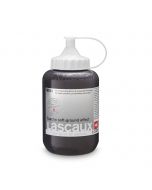
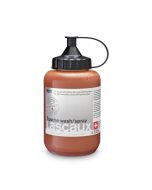
What Is Lascaux Tusche Wash
Lascaux Tusche Wash is a water-based tusche formulated to create washes, marks and tonal gradations on transparent supports (acetate, polyester film, drafting film) used for hand-made positives and photoliths. It behaves similarly to very fine Chinese ink, but with more even dispersion and controlled drying, making it ideal for creative photomechanical work.
It allows continuous-tone areas, soft transparencies and granular textures typical of traditional lithography, now applied to screen printing, photogravure and any UV exposure-based process.
How Tusche Wash Behaves: Tone, Dispersion and Texture
Controlled washes and tonal veils
It can be diluted to create very light transparent layers or denser mid-tones, ideal for building depth in a photolith.
Lithographic grain effect
Used undiluted or in layered applications, its particles create textures similar to classic stone wash effects—especially useful for organic screen printing textures without digital halftones.
Reactions with other liquids
Certain liquids (tannins, alcohol or aqueous solutions) can create reticulation and granular edges, expanding the range of marks.
Scratching, incisions and dry effects
Once applied, it can be worked with dry tools (blades, scribes, scrapers, wire brushes), creating fine non-printing lines and abrasion textures.
Compatible with additives and carborundum
Carborundum or abrasive powders attract the tusche, producing high-contrast textured areas.
Main Applications
-
Screen printing positives: washes, marks, granular textures, wear effects, transparencies, open lines.
-
Lithography and related methods: reproduces classic lithographic wash character.
-
Photogravure and photopolymer: tonal variation supports rich plates and grain.
-
Artistic offset and zincography: bridges autographic drawing and photomechanical steps.
-
Creative cyanotype: painterly positives and expressive washes.
-
Experimental techniques: reticulation, liquid interactions and additive textures.
Advantages Over Other Photolith Methods
Compared to opaque pens (Kuretake, Posca, Sakura Solid Marker)
Smooth tonal transitions that line tools cannot achieve. Greater painterly freedom. Works with broad washes and veils, not only lines.
Compared to Rubylith cut film
Much better for artistic washes and organic textures. No cutting or vector planning required.
Compared to digital inkjet/laser photoliths
Not dependent on digital halftones: more organic results. Direct physical manipulation with tools.
How to Use Lascaux Tusche Wash
1. Shake thoroughly before use
It is essential to disperse the particles evenly to avoid clumps or uneven deposits. The bottle includes mixing balls to help homogenise the tusche.
2. Use white dishes or porcelain palettes
These help you check the mixture and control density and uniformity.
3. Apply on transparent support
Recommended: matte polyester film for printmaking, drafting film, or technical acetate.
4. Modify with wet or dry tools
Brushes, palette knives and paint shapers, sponges or rags, scratching tools, carborundum or abrasives.
5. Allow to dry completely
This prevents layers from lifting or blending unintentionally.
6. Expose
Test exposure times depending on texture: longer exposures give sharper lines; shorter exposures preserve more grain and subtle texture.