What Is SolarFast?
SolarFast is a photographic printing system based on light-sensitive dyes developed by Jacquard. It belongs to a family of materials commonly used in solar printing, sun printing and other UV-based image-making processes, where exposure to ultraviolet light creates permanent images on a wide range of surfaces.
Its working principle shares similarities with historic alternative photography processes such as cyanotype, Van Dyke Brown, salt printing and other contact printing techniques. The key difference is that, instead of producing monochromatic images through metal-salt chemical reactions, SolarFast uses photosensitive dyes capable of creating images in multiple colours while offering excellent wash resistance on fabric.
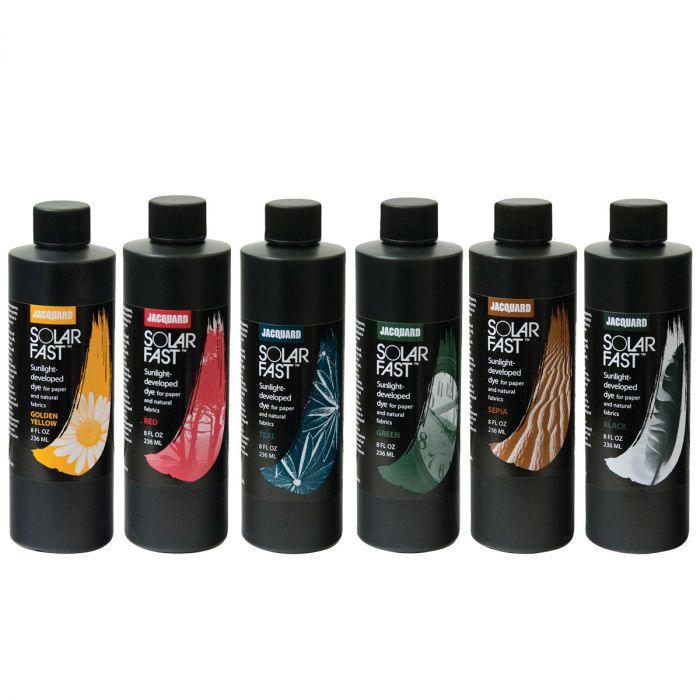
The 236 ml (8 oz) format is particularly suited to workshops, educational programmes, textile printing studios and artists who regularly work with solar printing and alternative photographic processes. Its larger capacity makes it easier to produce T-shirts, tote bags, decorative fabrics, print editions and group workshop projects without constantly replenishing materials.
Thanks to its combination of photography, textile printing and creative experimentation, SolarFast has become one of the most widely used materials within contemporary alternative photography and one of the most versatile solar printing systems available today.
How SolarFast Works
Exposure to sunlight or artificial UV light develops the image directly on the chosen surface, allowing artists to work with photographic negatives, digital negatives, photographic transparencies, handmade film positives, objects, plants, lace and many other materials capable of partially or completely blocking light.
SolarFast is applied directly onto the selected surface. Once coated, a photographic negative, transparency or object is placed over the image area and exposed to sunlight or a UV light source. After exposure, washing with SolarFast Wash removes any unreacted dye, revealing a clean and permanent image.
Unlike other alternative photographic processes such as cyanotype, SolarFast is designed to be exposed while the coated material still retains some moisture. If the dye is allowed to dry completely before exposure, colour intensity may be reduced. Conversely, excessive moisture can sometimes lead to condensation beneath the negative or transparency.
For this reason, many experienced users prefer to expose SolarFast while it remains slightly damp, helping achieve stronger colour saturation and improved image definition.
A Format Designed for Workshops and Production
The 236 ml format is intended for artists, educators and printmakers who use SolarFast on a regular basis, require larger coverage areas or work with multiple participants.
SolarFast 236 ml is particularly well suited to:
• Alternative photography workshops
• Art schools and educational programmes
• Textile printing and fabric decoration
• T-shirts, tote bags and decorative fabrics
• Artists producing editions or large-scale projects
Its larger volume helps reduce material costs per print while making it easier to work on projects where dye consumption is significantly higher. If you are looking for a smaller format for testing colours, learning the process or occasional use, SolarFast is also available in a 118 ml version.
Printing on Fabric and Paper
Although SolarFast was originally developed for textile applications, it also performs exceptionally well on many porous surfaces commonly used in alternative photography, contact printing and handmade printing techniques.
Suitable materials include:
• Cotton, linen, silk and canvas
• Watercolour paper and printmaking paper
• Cardboard, wood and other porous surfaces
On natural fabrics, SolarFast produces highly durable, wash-resistant images while preserving the original flexibility and feel of the material. The dye penetrates the fibres without creating a heavy surface layer, allowing detailed photographic images to remain soft and wearable.
This makes SolarFast particularly attractive to textile artists, fashion designers, illustrators, printmakers, educational institutions and creative workshops working at the intersection of photography and fabric printing.
SolarFast vs Cyanotype
SolarFast is frequently compared with cyanotype and other UV-based photographic printing processes. While both techniques use light to create permanent images, their chemistry, appearance and practical applications differ considerably.
| SolarFast |
Cyanotype |
| Available in multiple colours |
Characteristic Prussian Blue image |
| Ready-to-use product |
Requires emulsion preparation |
| Particularly suited to textile printing |
Traditionally used on paper |
| No chemical mixing required |
Requires preparation of sensitising solutions |
| Washed with SolarFast Wash |
Developed and washed with water |
If cyanotype represents one of the most iconic historical photographic processes, SolarFast can be viewed as a contemporary evolution of solar printing, designed for creating permanent photographic images on fabric, paper and other creative surfaces.
Available Colours
The current SolarFast 236 ml range includes the colours most frequently used by textile artists, creative workshops and alternative photography practitioners.
This selection covers the majority of applications in solar printing, textile printing, educational projects and experimental image-making:
Golden Yellow · Red · Blue · Green · Sepia · Black · Teal
All colours can be mixed together to create custom shades and expand creative possibilities.
If you are looking for a specific colour not currently listed, feel free to contact us regarding availability.
Working with Digital Negatives and Photographic Transparencies
The quality of the negative, film positive or photographic transparency used has a direct impact on the final image. As with cyanotype, Van Dyke Brown, salt printing and other contact printing techniques, achieving good density and tonal separation is essential for obtaining detailed results.
SolarFast performs exceptionally well with digital negatives printed onto inkjet transparency film, as well as with handmade film positives and professionally produced photomechanical films. This makes it a versatile option for educational workshops, textile printing studios and artists seeking accurate photographic reproduction.
If you would like to learn more about creating digital negatives, photographic transparencies or handmade film positives for alternative photography, UV printing and contact printing processes, we recommend exploring our specialised tutorials:
• Complete Guide to Photographic Positives and Film Transparencies
• How to Create Handmade Film Positives Step by Step
Frequently Asked Questions About SolarFast 236 ml
What Surfaces Can I Print on with SolarFast?
SolarFast performs exceptionally well on cotton, linen, silk, canvas, watercolour paper, printmaking paper, cardboard, wood and many other porous surfaces capable of absorbing the dye.
As a general rule, the more absorbent the material, the better the image quality and colour penetration will be.
Are the Images Wash Resistant?
Yes. SolarFast was specifically developed for use on fabric and produces highly durable images with excellent wash resistance.
When used correctly and processed with SolarFast Wash, the resulting prints remain stable through repeated washing and everyday use without requiring additional fixation treatments.
Does SolarFast Need to Be Dry Before Exposure?
No. Unlike cyanotype and some other alternative photographic processes, SolarFast is designed to be exposed while the coated surface still retains some moisture.
Allowing the dye to dry completely before exposure can reduce colour intensity. Excessive moisture, however, may sometimes lead to condensation beneath the negative or transparency and reduce image sharpness.
For best results, many experienced users expose SolarFast while it remains slightly damp.
Can I Print Photographs with SolarFast?
Yes. By using digital negatives printed onto inkjet transparency film or professionally produced photographic transparencies, it is possible to reproduce photographs with a high level of detail on both paper and fabric.
This makes SolarFast particularly attractive for alternative photography, solar printing and experimental image-making projects.
Who Is the 236 ml Format Intended For?
The 236 ml (8 oz) format is recommended for workshops, schools, textile artists, printmakers and anyone who uses SolarFast regularly.
It is especially useful when producing multiple prints, working with larger formats or teaching groups of participants.
How Much Surface Can 236 ml Cover?
Coverage depends on the absorbency of the material and the application method used. Under similar conditions, the 236 ml format provides approximately twice the coverage of the 118 ml version.
This makes it a more economical option for larger projects and frequent use.
What Is the Difference Between SolarFast 118 ml and 236 ml?
Both products contain exactly the same light-sensitive dye and produce identical results.
The only difference is the quantity supplied and the overall coverage available per bottle.
Can I Use UV Lamps or Exposure Units?
Yes. Although SolarFast was developed for sunlight exposure, it is fully compatible with UV lamps, professional exposure units, DIY UV boxes and other systems commonly used in screen printing, photomechanics and alternative photography.
Artificial UV light often provides more consistent results throughout the year.
Yes. SolarFast was specifically designed for natural fibres such as cotton, linen and canvas, making it ideal for T-shirts, tote bags, textile artwork and fabric-based photographic projects.
The resulting images remain soft to the touch while offering excellent durability and wash resistance.
SolarFast and the New Generation of Solar Printing Materials
SolarFast represents a contemporary evolution of historical light-based photographic printing techniques. While cyanotype, Van Dyke Brown and salt printing continue to play a fundamental role within alternative photography, SolarFast introduces new creative possibilities through its broad colour range, ease of use and outstanding performance on fabric.
Its ability to combine photography, textile printing and experimental image-making has made it a popular choice among artists, educators, photographers and creative studios around the world.
Whether used for workshops, educational projects, textile printing or photographic experimentation, SolarFast offers one of the most accessible and versatile approaches to contemporary solar printing.
A Versatile Tool for Alternative Photography and Textile Printing
The 236 ml format is particularly well suited to artists and educators who require greater coverage, produce work on a regular basis or need a reliable solution for workshops and group projects.
Its combination of colour, permanence and ease of use makes SolarFast one of the most widely adopted materials in contemporary alternative photography, solar printing and creative fabric printing.