The positive or photolith is the key element in any photomechanical printing process. It is, essentially, the image that will later be used to create screen printing stencils, offset plates, photogravure plates, polymer stamps, letterpress plates or any technique derived from photography, such as cyanotype.
If you are interested in autographic work and the manual construction of your own positives, these materials are designed for you. Each Lascaux Tusche offers specific advantages and can be combined with others within the same working system, significantly expanding the graphic and expressive possibilities of the positive.
What are Lascaux Tusches and what are they used for
The Lascaux Tusche range is a family of graphic materials developed specifically for the creation of manual positives, conceived for working in photomechanical processes from an autographic, experimental and artistic perspective.
These products allow you to draw, stain, erase, reserve or transfer textures directly onto transparent supports—such as matte polyester film, drafting film, technical acetate or specialised photolith films—which are later used in exposure or UV light processes.
Lascaux Tusches can be used in a wide variety of techniques, including:
-
Screen printing
-
Artistic offset and photolithography
-
Photogravure and photopolymer processes
-
Letterpress using photopolymer plates
As well as alternative light-based processes and solar-reactive techniques such as cyanotype, vandyke, collotype and other contemporary hybrid methods.
Unlike digital photoliths, Tusches allow the positive to be treated as a physical drawing space, where gesture, texture and plastic expression can merge with experimentation—and even error—as part of the final result.
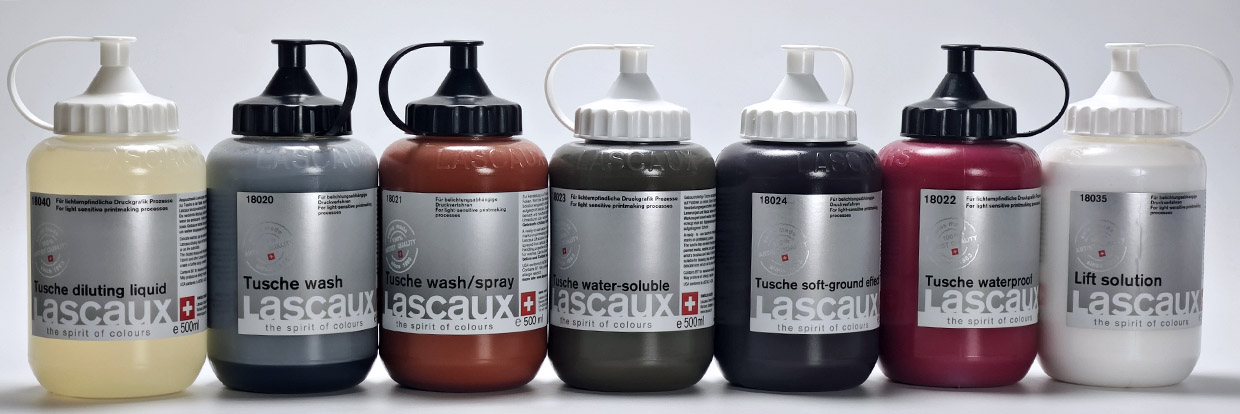
A Complete Range For Working The Positive As a Creative Space
One of the main strengths of the Lascaux Tusche range is that it is not a single product, but a complete family of complementary tools. Each fluid has its own specific behaviour, offering a wide plastic diversity within the creative process. They can be used independently or combined on the same substrate.
To illustrate the overall behaviour of these materials, we include below an explanatory video by artist and printmaker John McGowan, one of the leading advocates of the creative use of Lascaux Tusches in screen printing and manual photomechanical processes.
In this video, the differences between the various Tusches are clearly demonstrated, as well as their combined application to create autographic positives where multiple graphic resources—texture, tone and depth—can coexist.
For further insight into the use of these materials within a complete manual and photomechanical working system, we also recommend the book Screenprinting: The Complete Water-Based System, by Robert Adam and Carol Robertson, a key reference in contemporary water-based screen printing practice.
The Different Lascaux Tusches And Their Main Uses
Below we present the different possibilities offered by the Lascaux Tusche range. In each case, we summarise clearly what each product is used for and the type of results it allows. Individual product pages provide expanded information and specific demonstration videos.
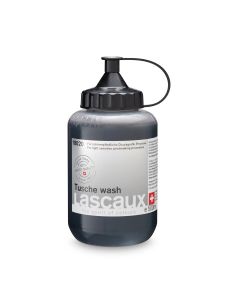
Lascaux Tusche Wash
Lascaux Tusche Wash is a fluid designed to create washes, glazes and continuous tonal textures on transparent supports. It allows the creation of grain, stains and smooth transitions similar to those found in traditional lithography, adapted to photomechanical processes such as screen printing or photogravure.
Main features:
-
Lithographic, organic-style washes
-
Ideal for mid-tones, glazes and stains
-
Perfect for pictorial manual positives
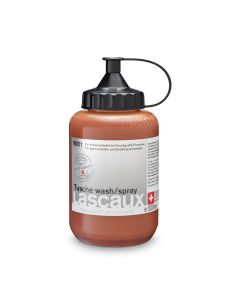
Lascaux Tusche Wash Spray
The sprayable version of Tusche Wash allows the positive to be worked through atomised layers, creating atmospheric backgrounds, fine grain and homogeneous textures without visible brush marks.
Main features:
-
Spray application
-
Organic textures and tonal backgrounds
-
Ideal for working in layers and contrasts
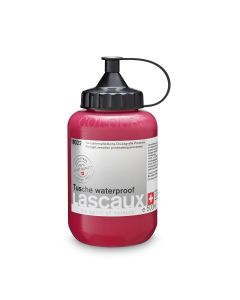
Lascaux Tusche Waterproof
A waterproof Tusche formulated to create stable marks, reserves and permanent lines that do not reactivate with water. It is especially useful for defining graphic structures that must remain intact when combined with other Tusches.
Main features:
-
Water-resistant once dry
-
Ideal for lines and reserves
-
Compatible with layered processes
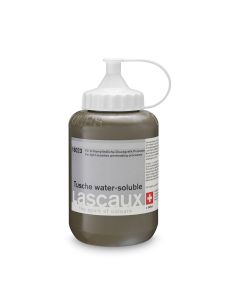
Lascaux Tusche Water-Soluble
A fully soluble and reactivatable Tusche, designed for open processes where the drawing can be erased, displaced or eroded even after drying.
Main features:
-
Reactivatable with water
-
Ideal for corrections and graphic wear
-
Perfect for experimental processes
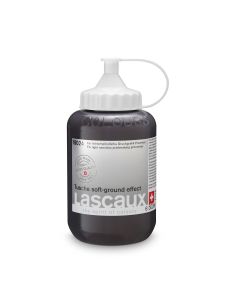
Lascaux Tusche Soft Ground Effect
A specialised product for transferring textures by contact, inspired by traditional soft ground etching. It allows fabrics, papers and organic materials to be captured directly onto the positive.
Main features:
-
Transfer of physical textures
-
Ideal for organic marks and patterns
-
Strongly material and gestural approach
Auxiliaries that can be combined with the Tusches
In addition to the Tusche range, Lascaux offers a series of technical auxiliaries which, when combined with some of these materials, expand their expressive possibilities and allow greater control over the graphic process. These are not drawing products, but tools that modify or condition the behavior of the Tusches.
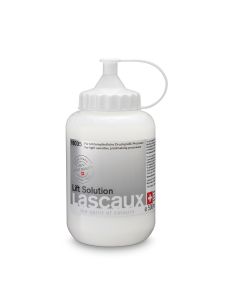
Lascaux Lift Solution
An auxiliary liquid used for working the lift technique applied to positives. This product does not function as a drawing ink, but as a resist agent. The image is built afterwards through the spray application of Tusche, generating contrasts and whites similar to those achieved with the calcographic sugar-lift technique.
It works especially well in combination with Lascaux Tusche Wash Spray, allowing the image to be constructed through contrast and enabling highly expressive textures and reserves.
Main features:
-
Technique similar to sugar-lift
-
Image construction through contrast
-
Ideal for clean whites and reserve areas
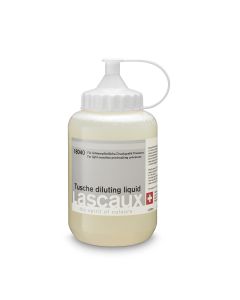
Lascaux Tusche Diluting Liquid
A technical medium designed to adjust the fluidity, transparency and drying time of Tusches without altering their stability. It provides much more precise control than simple dilution with water, especially for washes and layered work.
It is particularly suitable for use with Tusche Wash and Tusche Water-Soluble, where it offers greater tonal consistency and control.
Main features:
-
Control of viscosity and transparency
-
Ideal for washes and layers
-
Technical additive, non-printing